One record, carried from the first filing to the sale.
DealSTE is 4 phases and 20 rooms. Each room answers one question. The rooms ahead read as previews; the rooms behind stay readable as the record. Each phase writes its own paper from the deal as it stands.
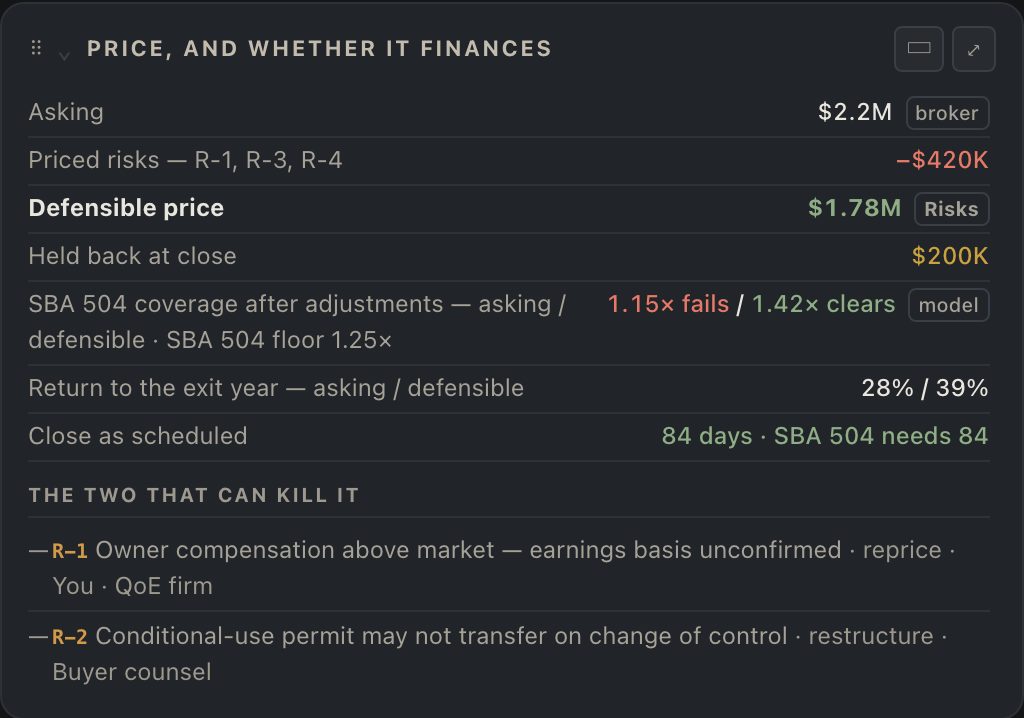
Find the company on the record, read what the registers hold on it, price it, and write the letter of intent.
- Brief — Should I care?
- Dossier — What's the proof?
- Underwrite — What's it worth?
- Risks — What could kill it?
- Act — What do I do?
- Phone script
- Email draft
- Letter — follow-up
- Information request + NDA
- Mutual NDA
- Indication of interest
- Letter of intent
- Seller-note term sheet
- Brief — the read
- IC screening memo
- Royalty and lease outline
- Consulting and transition — outline
- Permit transfer checklist
- Phase I — request for proposal
- Market and thesis report
- Offer of employment
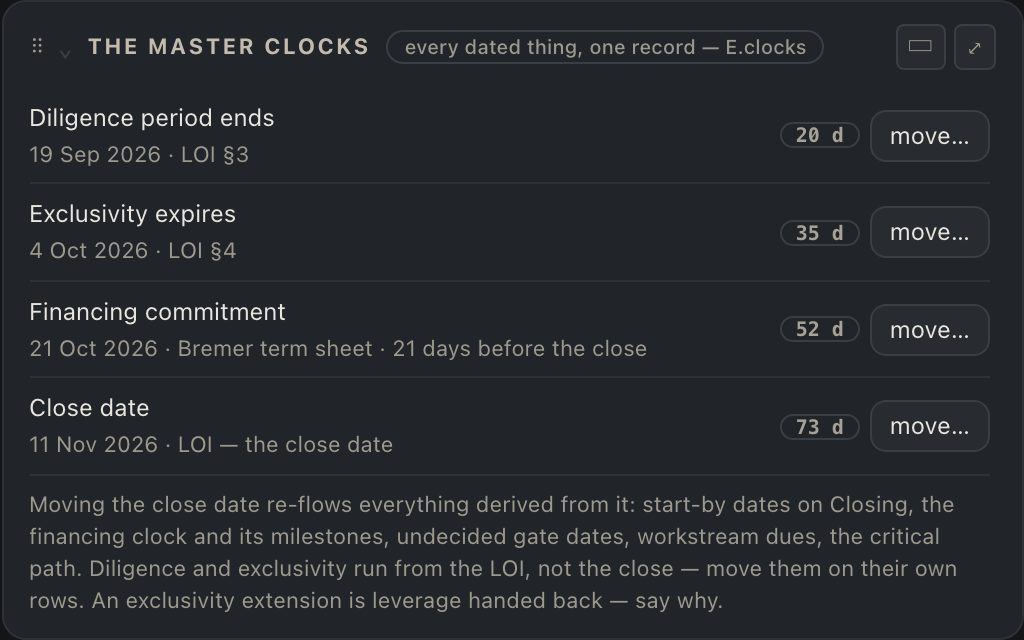
The dated path to the closing: diligence, terms, financing and closing, each dated from the day it must start.
- Clock — How long do I have?
- Diligence — What did we find?
- Deal room (the closing data room) — Where does it all land?
- Terms — What are we agreeing to?
- Financing — Does the money close?
- Closing — Can we close?
- Purchase agreement — counsel-ready draft
- Term sheet — from the ledger
- Day-one request list — to the seller
- Diligence report
- Gate memo
- Disclosure schedules — from the risk thread
- Funds-flow memorandum
- Closing binder — index
- Closing checklist — to the agreement
- Deal room — index
- IC final memorandum
- Quality of earnings — summary
- Capital partner — the deal in nine pages
- Status report — by workstream
- Weekly meeting — agenda
- Investor two-pager
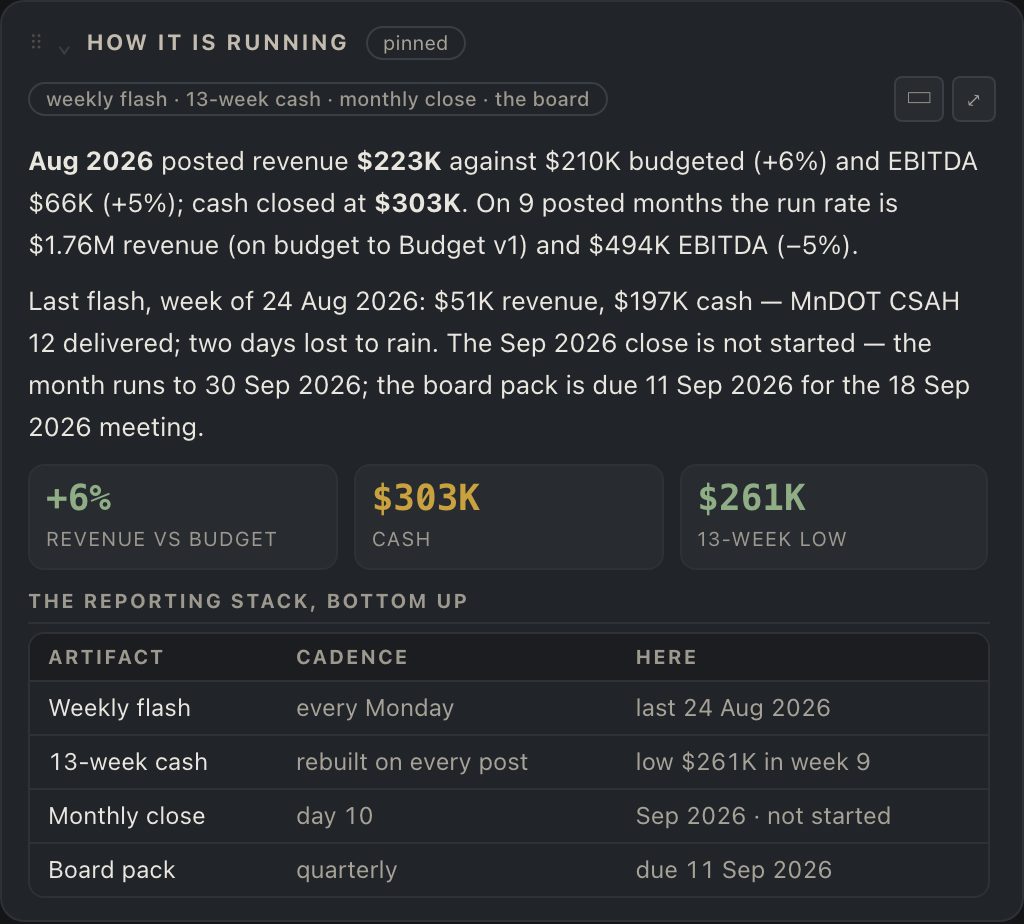
Day one, the cadence you run, a month against the model, and the obligations that come due.
- Day 1 & 100 days — What must be true on day 1?
- Cadence — How is it running?
- Model vs actuals — Is it what we underwrote?
- Obligations — What is owed, and when?
- Add-ons — What do we buy next?
- The first hundred days
- The budget book
- Valuation mark — memorandum
- Schedule K-1 pack
- Weekly flash
- Board pack
- Covenant compliance certificate
- Investor letter — this company
- Investor letter — the holdings
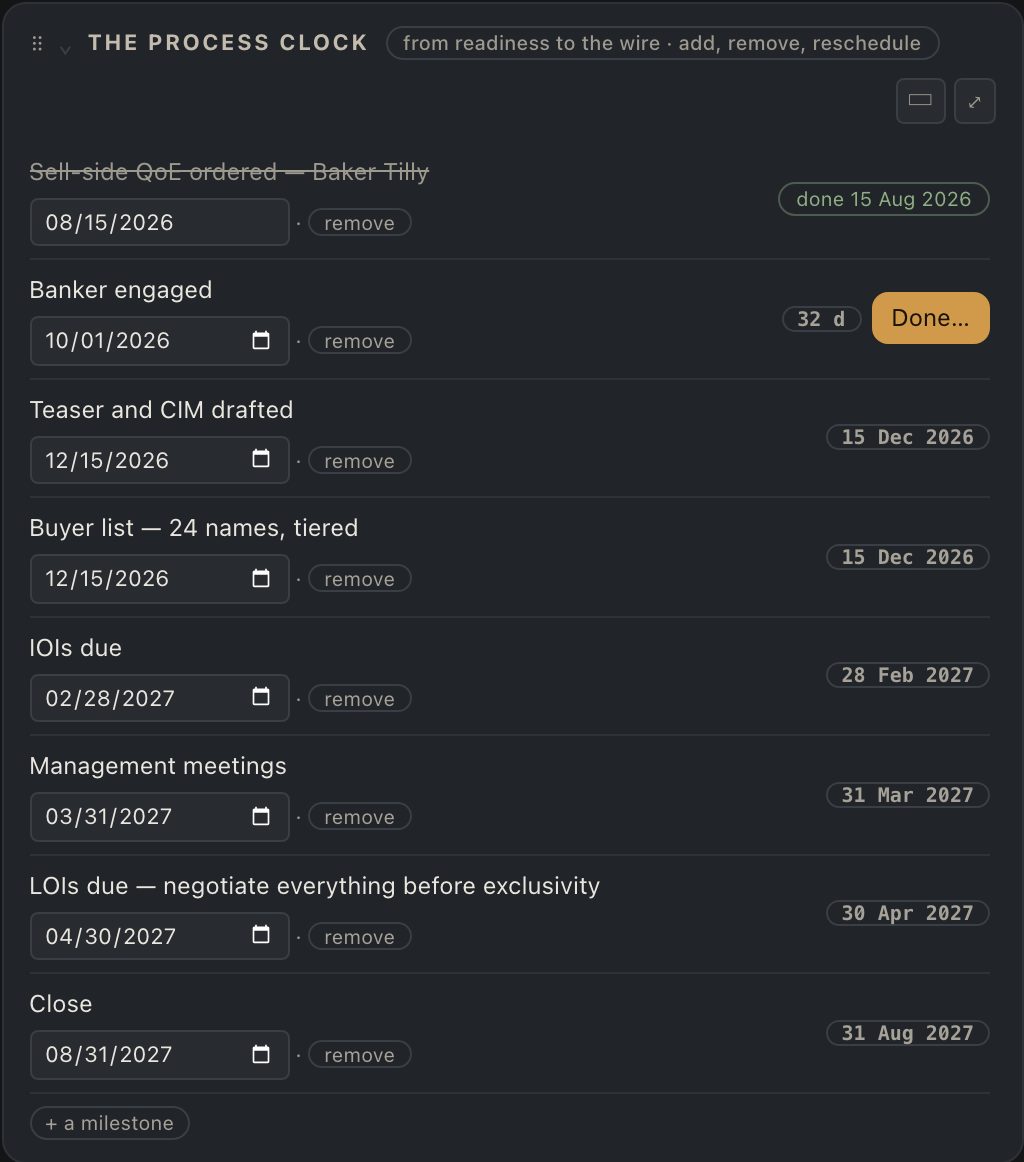
Would a buyer buy it — the punch list, then a data room built from the record you kept while you owned it.
- Readiness — Would a buyer buy it?
- Data room — Is the record ready?
- Process — Who is buying, and where are we?
- Tail — What is still owed after the wire?
- Exit-readiness report
- Teaser — the company unnamed
- Process update — memorandum
- Notice of distribution
- Term sheet — the seller’s side
- Confidential information memorandum
- Management presentation — outline
- Final returns
The software does not make things up.
A field the record cannot fill is written as “not on record”, never invented. Paper that goes to an owner never names the software.
When a register holds nothing, the answer is “not on record”, with what it would take to get it.
It raises risks and suggests a price. Every verdict is yours, and it records who made it.
It writes the letter of intent and the memos. You send them, and they never carry our name.
Participants in a company’s benefit plan are never written as its employees. An estimate is labelled an estimate and carries its method.
Request access
Signups are closed while we bring buyers on in small groups.
What happens after you send it
Not a sequence and not a bot. Every request goes to the owner of DealSTE.
By email, with a yes, a not yet, or a question about what you want to buy.
To a trial of every room, on the record we hold. Nothing is charged and no card is asked for.